Tuesday, 27 November 2012

100 years of Whitby Community College


Students and staff of Whitby Community College have been working hard putting together an exhibition to celebrate its 100 year history. The exhibition opens Friday evening and will be open during usual museum hours (admission charge apply)


Posted using BlogPress from my iPhone

Location:Whitby Museum

Thursday, 23 August 2012

A glimpse of a Maori cloak

Today I have been looking at the Museum register of objects to answer a query about some Maori cloaks in the museum collection. I thought it would be nice to show a glimpse of the decorative edge of one of these beautiful and fragile objects


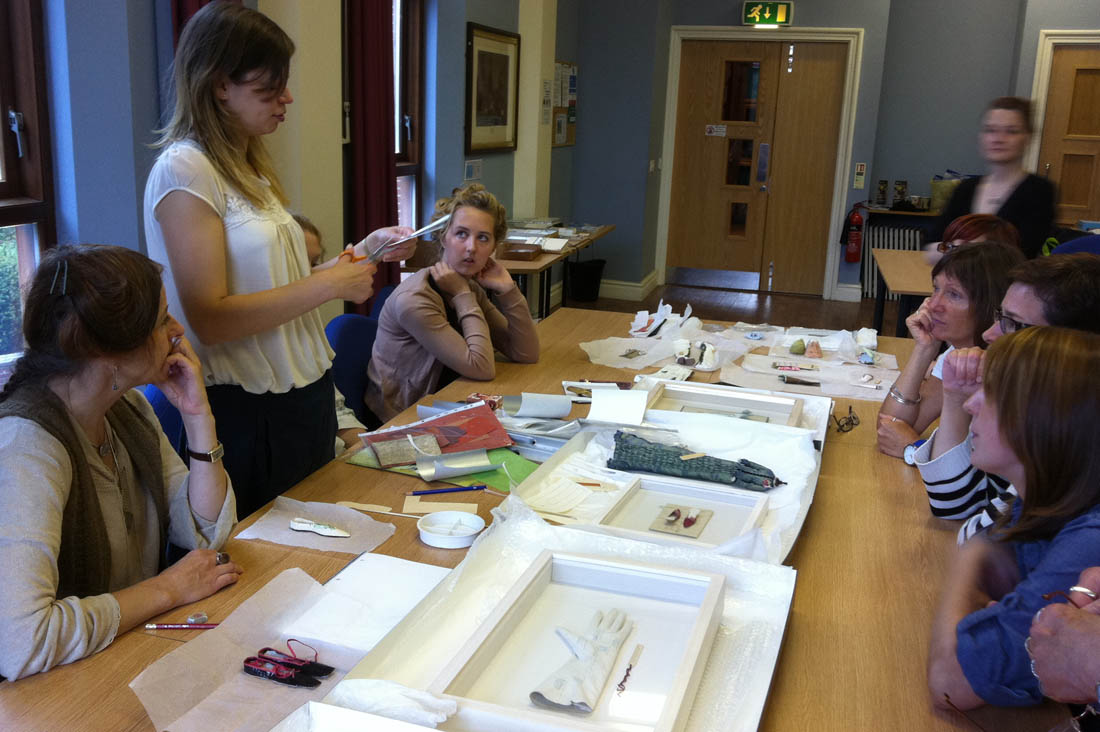
The cloak is made of flax fibres and the colour produced using natural local dyes. it is not possible to display the cloaks at the spent time and this photograph was taken during one of the regular checks made on items in store.

Location:Whitby Museum

A glimpse of a Maori cloak

Today I have been looking at the Museum register of objects to answer a query about some Maori cloaks in the museum collection. I thought it would be nice to show a glimpse of the decorative edge of one of these beautiful and fragile objects


The cloak is made of flax fibres and the colour produced using natural local dyes. it is not possible to display the cloaks at the spent time and this photograph was taken during one of the regular checks made on items in store.

Location:Whitby Museum

Thursday, 22 March 2012

Bram Stoker's holiday

A new exhibition about Bram Stoker opens in the Museum on April 2nd. He wrote the book Dracula (published in 1897) and included in three chapters of this book, considerable details about Whitby he gleaned whilst here on holiday in August 1890.

20th April 2012 sees the centenary of Bram Stoker’s death


Our exhibition on Bram Stoker incorporates the results of exciting new research by members of the Whitby Literary and Philosophical Society. Some research was done by Lit & Phil members in late 2011 that identified some hitherto unrecognised aspects of Stoker’s book. This was worthy of further effort and a team of researchers was gathered that took the work to a much more detailed level. All of the published work on the subject deals with Stoker’s Whitby aspects in variable but superficial detail that is often speculative and often inaccurate. Our work now reveals considerable new information as well as examining and exploring the influences upon Stoker while in Whitby as well as the basis for some of the characters.


Friday, 13 January 2012

Sailors' sixpence

The exhibition " Sailors' Sixpence : the lives of Whitby seamen revealed through the Muster Rolls " was officially opened yesterday by Captain S. L. Gamble, Master Warden, Trinity House, Hull.

These Muster Rolls are crew lists from the eighteenth and early nineteenth centuries and are now beginning to reveal the lives of Whitby seamen, telling tales of wars and trade, national events and personal tragedies.
In this exhibition, you can explore the history of these muster rolls, find out about their national importance, and learn about the conservation that will preserve their future.


- Posted using BlogPress from my iPhone

Location:Whitby Museum

Sunday, 1 January 2012

Good luck for the New Year

In Japanese, the Seven Gods of Luck are called Shichifukujin 「七福神」, from shichi 七 = seven, fuku 福 = happiness, good fortune and kami, jin 神 = god. The museum has a beautiful representation of Takarabune. In the ship are Fukurokuju (God of happiness, wisdom, longevity, virility and fertility), Hotei (God of happiness, satisfaction and abundance), Juroujin (God of longevity) and in the second row Bishamonten (God of war and warriors), Ebisu (God of good fortune, commerce and honest work), Benzaiten (Goddess of arts and knowledge) and Daikokuten (God of wealth and prosperity).

The  Museum will re-open on Tuesday 3rd January 2012. Please note that the café is closed from the end of November until mid-February.

Happy New Year! あけましておめでとう!

Tuesday, 16 August 2011

Mary's shoes

Today I have been a participant in a workshop run by local artist Serena Patridge and called 'Mary's shoes'. It was run to link in with the current exhibition in the Pannett Art Gallery, exploring the lives and art work of the Weatherill family, who were 19th Century Whitby artists.  Serena makes beautiful and intricate pieces of work with imagined histories and she demonstrated how to construct tiny shoes in paper and card. 
We all then made our own versions using the pretty papers and trimmings Serena had provided.

This is one of a series of events organised by the Pannett Art Gallery to link into the current exhibition.  There will be childrens Drama Workshops on 18th, 23rd, 25th, 30th August and 1st September (all starting at 1.30pm) and suitable for children between 8 and 11 years.  They will explore the lives of the people in the Weatherill paintings.  To book a place please telephone 01947602051.  There will also be a drop in day on Friday 26th August suitable for all ages exploring the lives and work of Whitby Women during the 1800-1900s and looking in particular at Ganseys and rag rugs.

Young consultants

On the 10th August we had a visit from a group of young people as consultants for the Precious Cargo project. I helped our Curator of World Cultures to introduce them to some of our Rich collection of objects. They are now going to do some background research for us. They were very excited at being able to take objects out of the display cases for a closer look. It was a fantastic morning as they were full of questions and enthusiasm, so it was a lovely thing to be a part of.


- Posted using BlogPress from my iPhone

Location:Whitby Museum

Saturday, 9 July 2011

Work experience

Last week we had a work experience student helping out in the museum for a few days.  She did get to help behind the scenes doing all sorts of jobs like moving some beaded purses out of their storage, photographing them and helping to put them into the new store.  On Friday she helped to move some Bronze Age pots from their usual display into another case temporarily, for safety while some changes are made to the lighting in the main hall of the museum.  Here she is putting the label into the case, having carried the objects and carefully placed them in their temporary home.

Thursday, 31 March 2011

Yesterday's celebration and student work

As part of the celebration of the re-opening of the Explorers wing of the museum we have a small display of student work on show.  This work was made by a group of young people in Year 10 at Whitby Community College.

It has been inspired by some of the objects from the Pacific that we have on display. These beautiful masks and shields were on temporary display in library yesterday together with many sketches and drawings.  I will add some pictures of the sketches and drawings to the blog later.

The pieces on the plinths (the first picture) will remain on display for a couple of weeks in the Explorers wing of the museum.

Wednesday, 30 March 2011

Grand re-opening

Today was the grand re-opening of the Explorers wing in the museum. Dr Sophie Forgan, Director of the Captain Cook Museum gave a short talk about the lives of objects. She used a small piece of Kauri gum as an illustration of the different journeys and stories that a modest object can tell.

The refurbishment has been a brilliant team effort and it was lovely to have so many people together this afternoon to share and celebrate our achievements.


- Posted using BlogPress from my iPhone

Tuesday, 29 March 2011

Re-opening of the Explorers wing

It has been a busy few weeks for the team of volunteers at Whitby Museum.  As one of the group of museums involved in a project called 'Precious Cargo' we have been working to make some of our objects from different world cultures more accessible to the visitors.


Some of the objects have now been displayed in new cases and others have been moved so that they are more easily seen.  This brightly coloured object is a bird shaped rattle from the Nootka Sound region of the North Americas.

The wonderful Maori Tiki has been raised up into position between the two new cabinets alongside the Waka Taua (Maori War Canoe models).  Tomorrow is the official re-opening and I must thank all the enthusiastic team of volunteers who have given their time to this including in particular Fiona Barnard, Holly Hyams, Rebekah Parkinson and Joan Edwards  Without the time and energy given by the volunteers none of this would be possible so well done to the whole team!  There is still plenty to get our teeth into though and we are planning a number of related events as well as working on refining the displays over the coming months.  


Saturday, 19 March 2011

Stories of the World

Our project at Whitby Museum is really beginning to take shape.  The two new cabinets are in place and we have begun to assemble the new display in one of the original cabinets.  All this extra space means that we are able to show objects that have been in storage for some time.
Here are some of the objects from Nootka Sound.  They include some wonderful examples are basketry including the hat (top left) that has patterns woven into the brim one of which is a striking Whale motif.    The basket (bottom left) is made of birch bark and the two large ladles from sheep horn.  There is still quite a bit of work to do including making some labels for these objects so that visitors can tell what they are.  Nootka Sound was one of the places visited by Captain James Cook, although these objects date from much later.

Work is still going on in other areas of the display including  more work on one of the model Maori War Canoes.  Here you can see Rebekah has re-attached a piece that had been broken off some years ago.  She has been working very carefully and, as is usual in a museum situation, everything has to be reversible at a later date if better methods become available.  It is fascinating to watch someone so skilful at work!


Wednesday, 9 March 2011

More work on the displays

The new cabinets are in place and we have begun work on the re-display of the objects as part of our Precious Cargo and Stories of the World project.  These two new cabinets house two large model Maori War Canoes (left hand cabinet) and objects including some intricately carved ceremonial adzes.

Tuesday, 1 March 2011

Lime Spatulas

Today I haven't got quite as much done as I had hoped but I have unpacked these carved wooden spatulas and put them back on display. They are from the region of Papua New Guinea and are beautiful examples of carved work. So many of the objects in this part of the museum include really expressive faces as part of the decoration.


Monday, 21 February 2011

The new cabinets arrive

Today Chris Hunter has delivered the new cabinets. This is the beginning of their journey from truck into the museum. Chris had been in and measured the spaces between the displays at the back of the museum and there was just enough room to get the new cabinets in without moving anything.


Here they are at the end of a very busy and successful day. You can see that the canoes are now in their new resting place and we began to put some of the objects into the other case, but still have quite a bit to do. Happy day!

Wednesday, 16 February 2011

Beginning the new displays

I have had two enjoyable days working with Joan and beginning to unpack objects and put them back on display.


Here is the first part of the display (apologies for the reflections, I should have taken the photos while the doors were still open).


- Posted using BlogPress from my iPhone

Tuesday, 8 February 2011

Beginning to put it all back

The Cook & Scoresby wing of Whitby Museum has now been repainted and we can begin to put things back on display.  Fiona has been working really hard to re-display the collection that relates to the two Captains Scoresby, father and son.  The Scoresby collection is a mixture of objects from the regions around the Arctic where they were engaged in whaling.  Captain Scoresby Junior was also a scientist and so there are many artefacts he constructed as part of his investigations into magnetism and other experiments.  There are a few Inuit items and some very beautiful carved tusks now returned to display.

This is the view into the other end of the room and you can see we still have a lot of work to do.  The two new display cabinets will be located against the wall at the far end of the room, hopefully with the Maori Tiki figure between them.  The figure standing in the corner of the room in the above photo is of Captain Cook and usually stands on top of the hexagonal cabinet, but we took him down while we re-positioned the cabinet, so one of the next jobs is to put him back.  Today we have begun to think in more detail about where things will go and how they will be supported within the cabinets, to give visitors the best possible view.


Here are the two new cabinets under construction in Chris Hunter's workshop.  I took this photo a week ago and work is making quite rapid progress.  I love the corner detail which Chris has copied to match two of the existing cabinets.  The opportunity to work with such a skill craftsman has been brilliant.  He really listens to what is needed and comes up with ideas and solutions to help.

Tuesday, 25 January 2011

A bit of a mystery?


Do you know anything about this figure?  What was its function?  It has been on display in the Scoresby collection since at least 1990, but perhaps since 1823.  It is described in the catalogue as being made of skin, wetted and stretched over wood, probably North American.  It is labeled as the figure from a model kayak.

We were alerted to the figure’s strangeness by a visiting Alaskan researcher who commented that she had never seen anything like it and suggested we seek expert advice.  We have contacted various museums with Arctic collections but so far to no avail.  The Smithsonian Arctic Studies Center and the New Bedford Whaling Museum have seen nothing similar.
The figure is 40 cm (18 inches) tall and the oval base is approx 15 x 12 cm.  It feels surprisingly heavy, at around 3 to 4 lb.   Close examination shows several pieces of metal, including a nail sticking out near the top of the head.  The arms are jointed at the shoulders and may be attached with metal.  It looks as if the skin is attached with small tacks and there is no trace of stitching.  The skin over the top of the head is blackish.  The oval incision on the chest is deliberate and goes right through the skin in places. In several places there are marks of ?hessian on the skin, as if the figure was wrapped in cloth while the skin was wet.
Our figure is odd because wood is scarce in Polar regions, so a heavy wooden object is unusual and perhaps significant.  Arctic peoples moved frequently so their possessions were light and portable.  Kayaks and larger boats were made from sealskin.   The materials, workmanship and appearance are not European looking and are probably circumpolar if not Inuit.

The Museum would love to hear from you if you have any information about our strange figure, or if you have seen anything similar.

(This article was written by Fiona Barnard)


Wednesday, 12 January 2011

Another view

I have spent a bit more time today carefully cleaning one of the Maori model canoes. Here is a picture of another of the carved figures. In my blog post yesterday I said that I thought most of the carved figures were male but today I have changed my view and think there are a mixture of male and female figures depicted. I am still fascinated by the amount and variety of patterns carved so intricately all over the canoe. I still have a lot of cleaning to do and am working quite slowly, a small section at a time.


- Posted using BlogPress from my iPhone